By flower · all year
Gerberas: the happiest flower in the bouquet
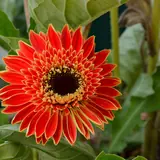
Round, flat and brightly colored, the gerbera looks like a child drew it. It is the flower of joy and one of the easiest to find in any month.

- Scientific name
- Gerbera jamesoniinative to South Africa
- Season
- All yeargreenhouse-grown
- Meaning
- Joy and innocenceand energy
- Vase life
- 7 to 10 daysin shallow water
What it means to give gerberas
The gerbera is the flower of joy, innocence and good cheer. It doesn’t carry the romantic weight of the red rose or the remembrance of the chrysanthemum, so it is one of the easiest flowers to give: it works for a friend, a coworker, a teacher or your grandmother.
By color, yellow speaks of friendship, orange of energy, pink of affection and admiration, red of love and white of purity. There is more in our guide to flower color meanings.
From South Africa to the world
The gerbera is native to South Africa, where it is known as the Transvaal daisy. It is named after the German naturalist Traugott Gerber. In the late 19th century breeders in Europe began crossing it to get bigger flowers in more colors, and today it is one of the best-selling cut flowers in the world.
When gerberas are available
They are greenhouse-grown all year, so they are easy to find in any month. In the seasonal flowers table they appear like this:
- Spain: out of local season (greenhouse-grown or imported).
- Mexico and Central America: January, February, March, April, May, September, December.
- Argentina, Chile and Uruguay: out of local season (greenhouse-grown or imported).
When to give gerberas
- Birthdays: a mixed bouquet of gerberas is one of the happiest there is.
- Graduations: they hold up well in photos and in the heat of the ceremony.
- Teachers’ Day: an affectionate gift with no romantic undertones.
- To cheer someone up who is ill or has had a bad week.
- Children: they love the colors and the cartoon-like shape.
How to care for a bouquet of gerberas
- Shallow water: 3 to 5 cm (1 to 2 in) in the vase. It is the most important trick.
- Cut at an angle with a clean knife or scissors, ideally under the tap.
- Clean water every two days and a washed vase: bacteria are their worst enemy.
- If a flower droops, trim the stem and wrap the bouquet in newspaper in water for a few hours so it straightens.
Potted gerberas
As well as in bouquets, gerberas are widely sold in pots, as an indoor or patio plant. It is a gift that blooms for several months if well cared for:
- Plenty of light: by a bright window; in summer, out of the strong midday sun.
- Water from below: pour water into the saucer and empty what is left after 15 minutes. If the center of the plant gets wet, it rots.
- Remove spent flowers by cutting the stem at the base: that way it produces new ones.
Frequently asked questions
What does it mean to give gerberas?
Joy, innocence and good cheer. It is a flower with no romantic or sad connotations, so it works for almost anyone and any occasion.
What does each gerbera color mean?
Yellow, friendship and joy; orange, energy; pink, affection and admiration; red, love; white, purity. Mixed colors simply say “have a great day”.
How do I make gerberas last longer?
Put them in shallow water, 3 to 5 cm (1 to 2 in): their stems are hairy and rot quickly if deeply submerged. Cut the stems at an angle, change the water every two days and remove any that droop.
Why do gerberas droop?
Because an air bubble or bacteria block the stem and water can’t reach the flower. Trim 2 cm (1 in) under the tap and put them in fresh, clean water.
Is a gerbera the same as a daisy?
They belong to the same family, the Asteraceae, but the gerbera has a bigger, flatter, brightly colored flower and is grown mainly as a cut flower.